02 — UX Research · Group Project

Beyond the
Household

A research study into how Indian homemakers create and grow businesses — their motivations, the barriers they face, and the support systems they need to succeed.

Group Project UX Research 1.5 months Field Study · India

The Indian homemaker is entering
entrepreneurship at scale.

India's informal economy has always included homemakers running small trades and craft businesses. But something is changing — the ambitions are broader, the scale is different, and the gap between those ambitions and the available infrastructure is growing.

Access to skills, business resources, and peer support is fragmented and often inaccessible. This study set out to understand that gap from the inside.

Illustration of a homemaker running forward carrying a bag of goods, with a seller dashboard graphic behind her representing her growing business
  1. 01 Understand the motivations driving homemakers into entrepreneurship
  2. 02 Identify the barriers that prevent them from growing or scaling
  3. 03 Map the decision-making patterns that shape their business journeys
  4. 04 Surface opportunities for scalable, product-driven interventions
A six-week study across two phases

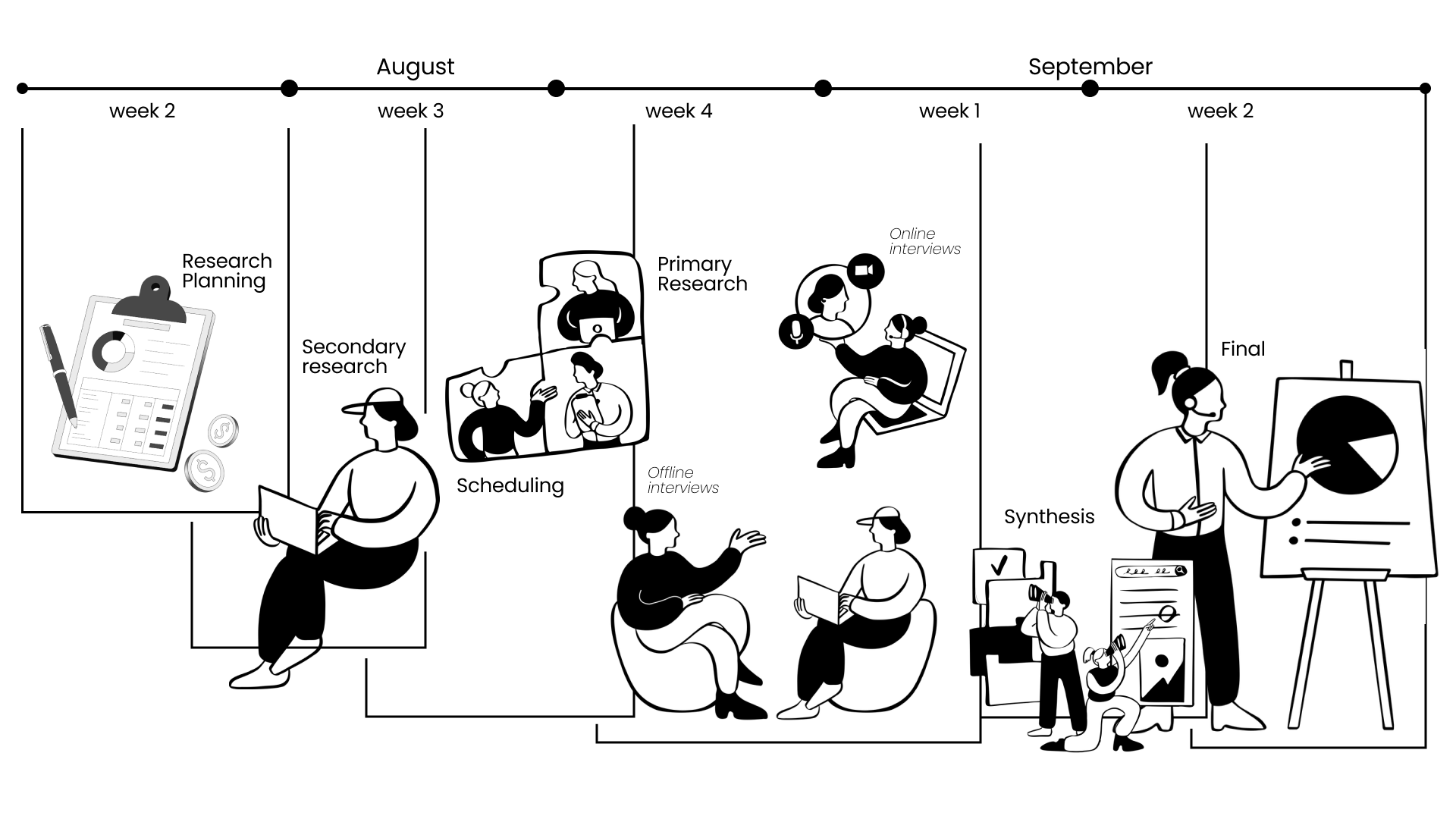
Project Timeline
Project timeline: Research Planning (Aug week 2), Secondary Research (Aug week 3), Scheduling (Aug week 4), Primary Research — online and offline interviews (Sep week 1), Synthesis (Sep week 2), Final presentation.

A two-step approach — open first, then deep

We began without a fixed script. The goal was to hear participants describe their reality in their own terms before we formed any hypotheses.

Step 1
Secondary Research &
Unstructured Interviews
Desk research and literature review Open-ended, unstructured conversations

We mapped the broader landscape through existing literature, then moved into open-ended conversations with participants — no script, no agenda, no preconceived notions about what we expected to find.

The participants defined the conversation. We followed.
Step 2
Cognitive Walkthrough
Interviews & Shadowing
Structured cognitive walkthroughs Observation and shadowing

We then followed participants through their daily routines — watching how they managed their businesses alongside their households. This gave us a holistic view of their digital literacy, time management, and the full texture of their working lives.

Understanding behaviour, not just reported opinion.

Who we spoke with,
and what we explored

Participants were grouped by business stage — from those still figuring out how to start, to those already operating at scale. This let us capture how needs and challenges shift across the entrepreneurship journey.

A
Starting from scratch
A vague idea, no clear path forward

Participants at this stage had an interest in starting a business but were still learning how to begin. The primary challenge was knowing where to start — not just what to do, but in what order.

B
Growing an existing idea
Clear direction, ready to scale

These participants had established something small and were navigating the shift to slightly larger. Scale felt aspirational, but practical constraints — time, money, support — were limiting what was possible.

C
Scaling an existing business
Established operations, seeking growth

Participants at this stage had sizeable businesses and were actively looking for growth opportunities — particularly around efficiency, reach, and long-term financial sustainability.

Three lenses for every conversation

Every interview was guided by three areas of focus — broad enough to leave room for the unexpected, specific enough to ensure we came away with actionable understanding.

Systemic Gaps & Opportunities

Skill development pathways, support networks, and barriers to digital access within the broader ecosystem — the structural problems that individual effort alone can't solve.

Socio-Cultural Influences

The personal, familial, and cultural factors that shape a homemaker's willingness and capacity to pursue entrepreneurship — and the invisible constraints that rarely show up in structured survey responses.

Practical Support Needs

The concrete help, resources, and guidance participants actively needed — and weren't consistently finding. The gap between what exists and what is actually accessible.

Four insight clusters

Each insight is grounded in direct participant quotes and paired with a rephrased How Might We question that defines the design opportunity it opens.

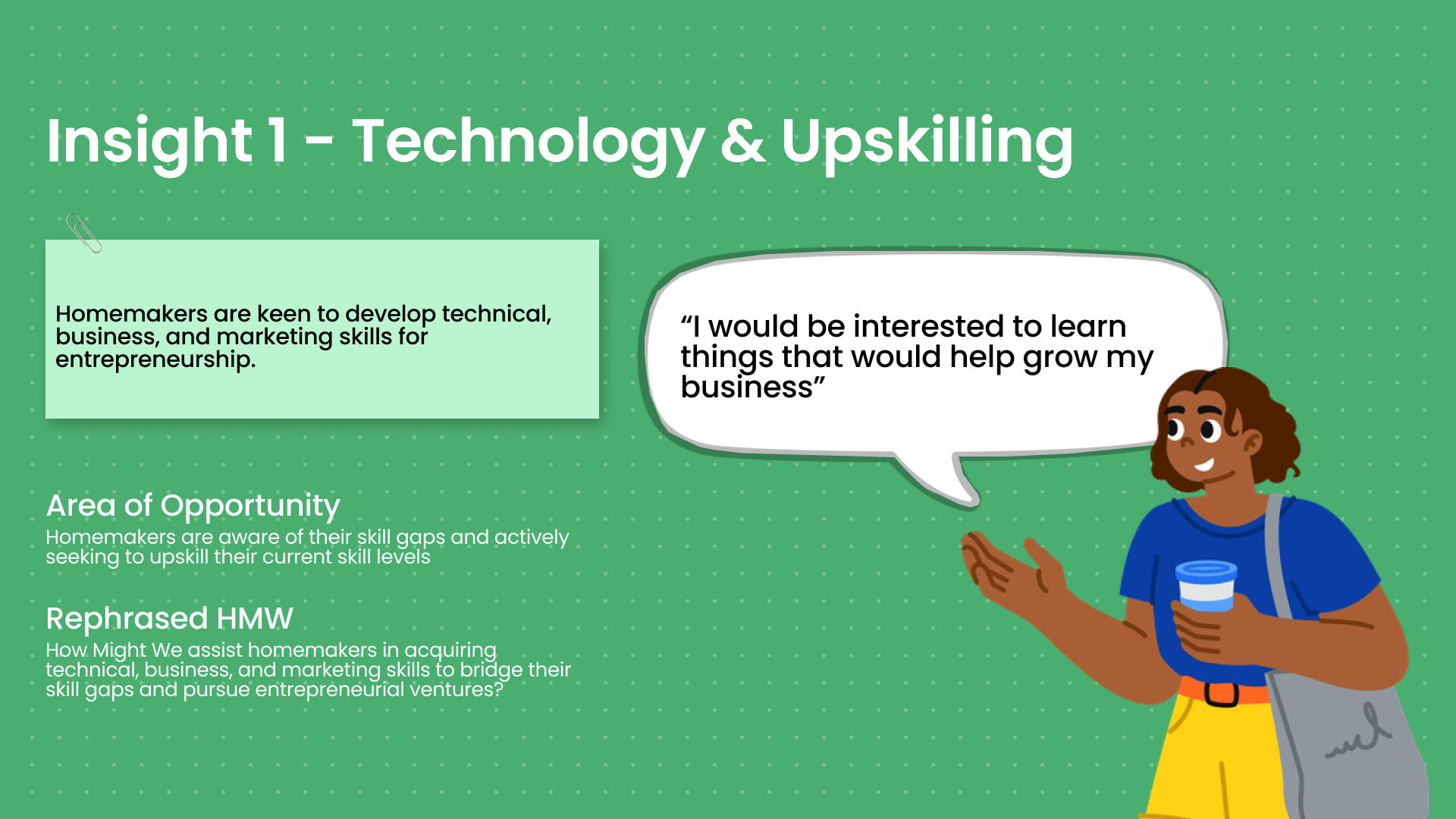
Insight 1 — Technology & Upskilling
Insight 1: Technology and Upskilling — Homemakers are keen to develop technical, business, and marketing skills. Quote: 'I would be interested to learn things that would help grow my business.' HMW: How might we assist homemakers in acquiring skills to bridge skill gaps and pursue entrepreneurial ventures?
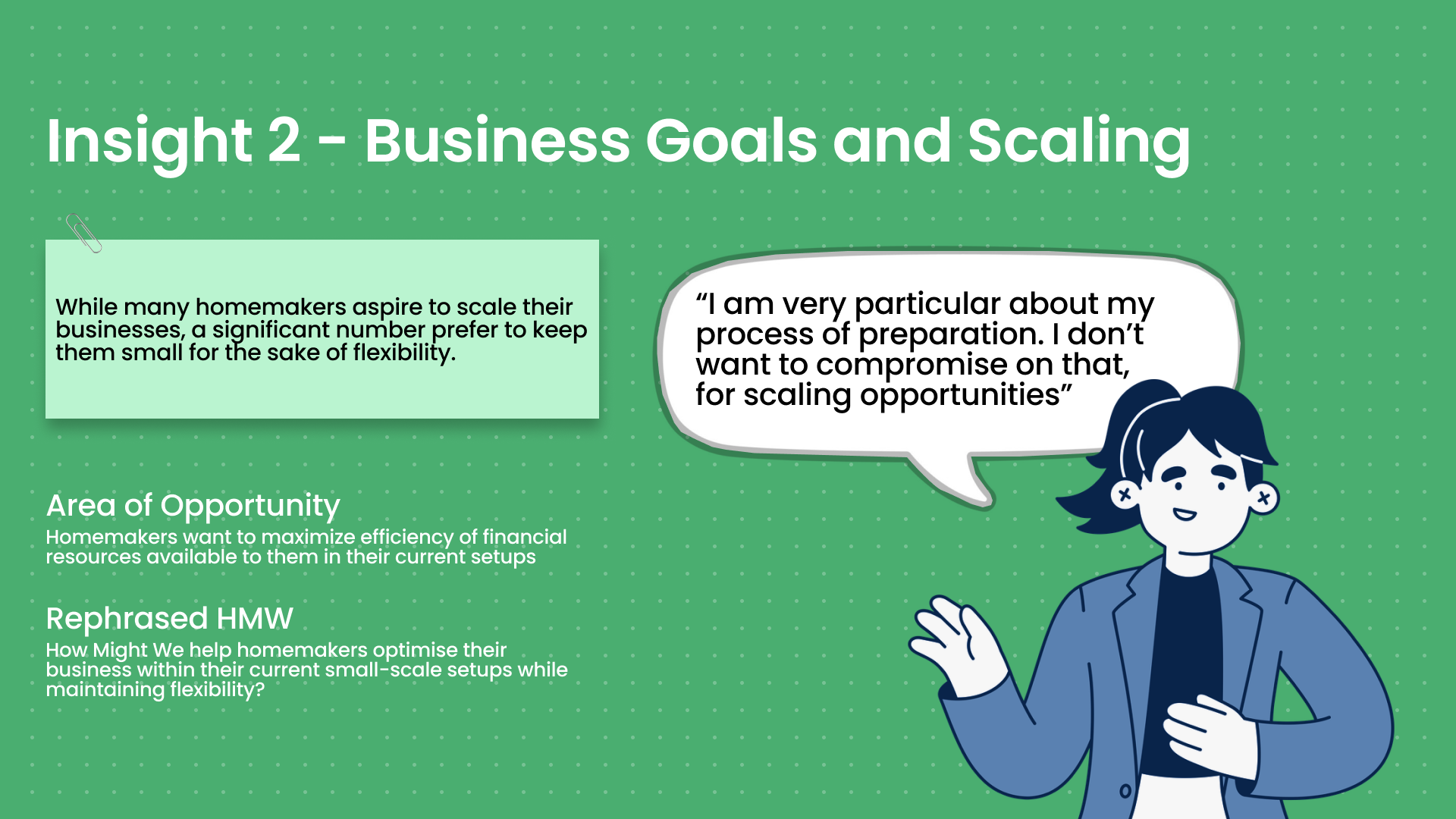
Insight 2 — Business Goals & Scaling
Insight 2: Business Goals and Scaling — Many aspire to scale but a significant number prefer small for flexibility. Quote: 'I am very particular about my process. I don't want to compromise on that, for scaling opportunities.' HMW: How might we help homemakers optimise within their current small-scale setups while maintaining flexibility?
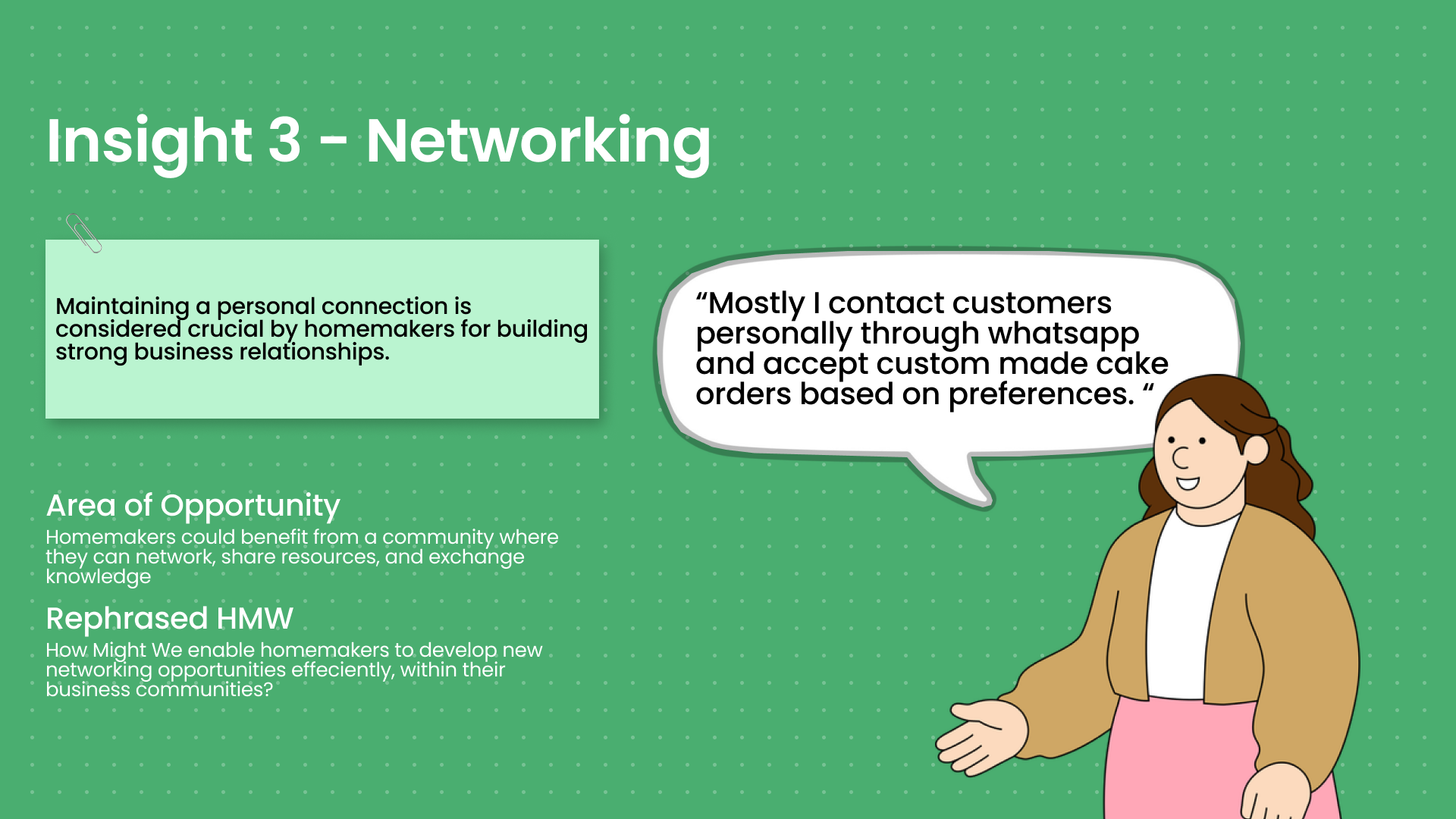
Insight 3 — Networking
Insight 3: Networking — Maintaining personal connection is crucial for strong business relationships. Quote: 'Mostly I contact customers personally through WhatsApp and accept custom made cake orders based on preferences.' HMW: How might we enable homemakers to develop new networking opportunities efficiently within their business communities?
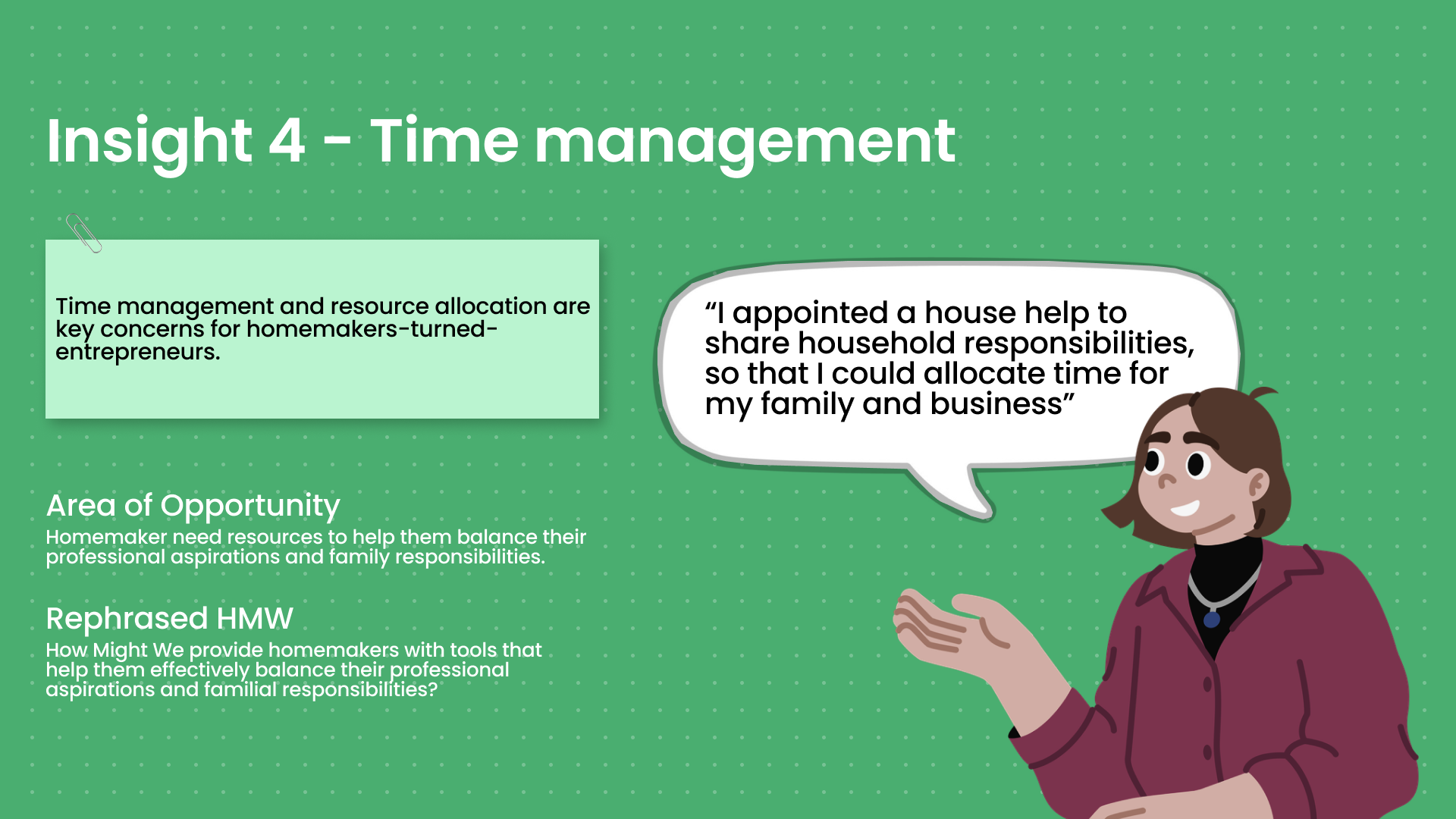
Insight 4 — Time Management
Insight 4: Time Management — Time management and resource allocation are key concerns. Quote: 'I appointed a house help to share household responsibilities, so that I could allocate time for my family and business.' HMW: How might we provide homemakers with tools to effectively balance professional aspirations and familial responsibilities?
05 — Behavioural Patterns

What observation kept revealing

Interviews tell you what people say they do. Observation and cognitive walkthroughs show you what they actually do — and there's often a gap between the two. These four patterns didn't come from any single conversation. They came from spending weeks watching participants work in their real environments.

Pattern 01
They were already running at full capacity

Running a household and a business at the same time doesn't leave much spare room. Participants had quietly found ways to keep things manageable — favouring approaches that didn't pile on extra effort. When something new had too steep a learning curve, it wasn't dismissed outright; it just never got started. They weren't avoiding complexity out of laziness. They were protecting the energy they needed to keep everything else going.

Design Consideration

When someone is already juggling two full-time roles, even a temporary learning curve can be enough to put something off permanently. Making things easy to pick up isn't just a nice touch — it's the difference between something being used and something being quietly set aside.

Pattern 02
Advice landed better when it came from lived experience

Participants were more likely to act on advice from someone who'd been through the same thing than from a resource that offered general guidance. It wasn't that they were dismissive — they were practical. Generic business advice often felt like it was written for someone else's situation. But a tip from someone who'd run a similar business, in a similar context, with similar constraints? That felt immediately useful. Who the advice came from mattered just as much as what it said.

Design Consideration

Generic guidance, however good, can struggle to feel relevant when the audience can't see their own situation in it. Support that's grounded in experiences that actually resemble the user's own tends to carry a different kind of weight.

Pattern 03
They stretched existing tools before switching to new ones

Nobody picked up new tools when they started their business — they repurposed the ones they already had. WhatsApp became a way to take orders, answer questions, and stay in touch with regular customers. Notebooks tracked inventory. Phone camera rolls doubled as product catalogues. This showed up across every participant group, regardless of how long they'd been running their business. Before anyone committed to something new, they first tried to make what they already trusted work harder.

Design Consideration

Tools that slot into what someone already does are a much easier sell than ones that ask them to start from scratch. When something feels like a natural extension of an existing habit, it doesn't feel like a risk.

Pattern 04
Confidence came from doing — not from waiting to feel ready

The participants who had made the most progress were also the most willing to take the next step — not because they were naturally bolder, but because each small success made the next thing feel more manageable. Confidence wasn't something they built up before they started. It grew as they went. And the participants who were waiting until they felt ready before beginning were, in most cases, still waiting.

Design Consideration

Getting someone to take the first step — even a small one — matters more than giving them the full picture upfront. Once the first step works, the next one becomes much easier to take.

The potential at scale

400 million women.

By 2030, India's working age population will surpass 1 billion. If current trends continue, the economic potential of 400 million women may be left unaddressed — not because of lack of ambition, but lack of infrastructure.

Source: Bain & Company, Google — 2019

Economic
Job creation

Income diversification and household-level job creation with ripple effects across communities.

Social
Multiplier effect

Successful homemaker entrepreneurs reinvest in their families and networks — compounding welfare across communities.

Personal
Autonomy & agency

Financial independence shifts the balance of control — in households, in relationships, and in self-perception.

Innovation
New markets

A previously underserved segment with distinct needs creates entirely new product and service opportunities.

Four directions that emerged

Each direction addresses a different dimension of the problem space — from skill acquisition to time management to community connection.

Skill Monetization Platform
01

Skill Monetization Platform

Tools for business setup, marketing, and financial management.

Lifelong Learning Hubs
02

Lifelong Learning Hubs

Flexible, bite-sized courses in entrepreneurship and digital skills.

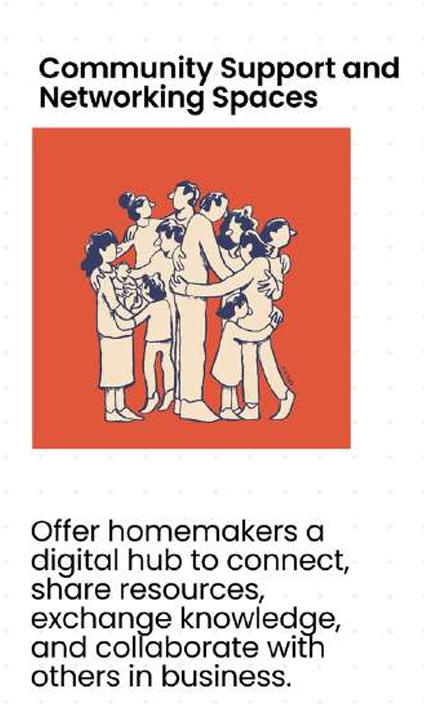
Community Support and Networking Spaces
03

Community Support and Networking Spaces

A digital hub to connect, share resources, and exchange knowledge.

Work-Life Balance Tools
04

Work-Life Balance Tools

Task management, time blocking, and family collaboration.

What the research taught us
about research itself

Beyond the findings, the process surfaced three meta-learnings — about how to design research for this audience, and what assumptions to leave behind when you start.

01
Design for context,
not category

Every homemaker's business existed in a unique ecosystem — her household setup, family dynamics, cultural context, and personal ambition were all different. Solutions that treat "homemaker entrepreneurs" as a uniform group will consistently miss the lived reality of individuals within that group. Flexibility and adaptability aren't features — they're functional requirements.

02
Time is a key
usability constraint

For this audience, cognitive load and time efficiency aren't preferences — they're non-negotiable. Every tool, service, or interaction must fit into gaps within a schedule that is already structured around other people's needs. Complexity isn't just frustrating; it's disqualifying. This needs to be treated as a first-order design constraint, not an edge case.

03
Empathy starts
with listening

Our most valuable insights came from unstructured, open-ended conversations — not from the structured interview questions we had prepared in advance. The participants defined the agenda. The motivations and challenges that emerged from those conversations were ones that structured surveys would have missed entirely. Starting with listening, rather than with hypotheses, changed everything about what we learned.

What came next

One direction
went further

The research concluded with four possible directions. Each was grounded in something real the participants needed. But one kept reappearing underneath every other finding — not as a standalone category, but as the missing layer connecting all the others.

Community Support and Networking Spaces. The isolation homemakers described was not incidental. It shaped how they learned, how they found customers, how they priced their work, and how they thought about growth. A connected ecosystem would not just solve a networking problem — it could provide the shared infrastructure that all the other needs were missing.

That question became the subject of a dedicated product design project. What would it actually take to design that ecosystem from first principles — the information architecture, the trust model, the surfaces, the interactions? The research had identified the space. The next step was to build something inside it.

The continuation of that exploration is presented in the next case study.

Juno — Community Platform for Homemaker Entrepreneurs →
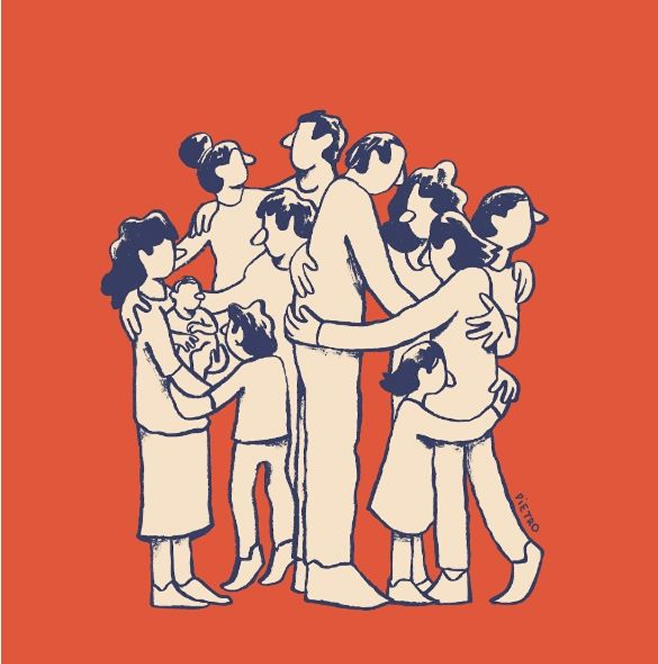
Illustration: Community Support and Networking Spaces — offer homemakers a digital hub to connect, share resources, exchange knowledge, and collaborate with others in business.